 |
Habari STOMP Client for OpenMQ 9.0
Object Pascal STOMP client library for OpenMQ
|
|
Habari STOMP Client for OpenMQ 9.0
Object Pascal STOMP client library for OpenMQ
|
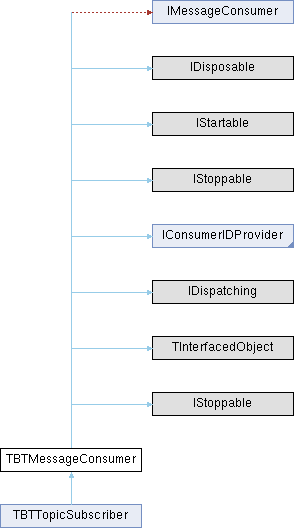
A client uses a MessageConsumer object to receive messages from a destination.
More...
Public Member Functions | |
| TBTMessageConsumer (const TBTSession Session, const TBTConsumerID ConsumerID, const IDestination Destination, const string Name, const string Selector, const Boolean NoLocal, const IMessageListener Listener) | |
| ~TBTMessageConsumer () | |
| Close () | |
| Closes the message consumer. | |
| string | GetMessageSelector () |
| IMessage | Receive () |
| IMessage | Receive (const Integer Timeout) |
| IMessage | ReceiveNoWait () |
| Receives the next message if one is immediately available. | |
| Start () | |
| Stop () | |
 Public Member Functions inherited from IConsumerIDProvider Public Member Functions inherited from IConsumerIDProvider | |
| TBTConsumerID | GetConsumerID () |
Protected Attributes | |
| Boolean | NoLocal |
A client uses a MessageConsumer object to receive messages from a destination.
A MessageConsumer object is created by passing a Destination object to a message-consumer creation method supplied by a session.
MessageConsumer is the parent interface for all message consumers.
A message consumer can be created with a message selector. A message selector allows the client to restrict the messages delivered to the message consumer to those that match the selector.
A client may either synchronously receive a message consumer's messages or have the consumer asynchronously deliver them as they arrive.
For synchronous receipt, a client can request the next message from a message consumer using one of its receive methods. There are several variations of receive that allow a client to poll or wait for the next message.
For asynchronous delivery, a client can register a MessageListener object with a message consumer. As messages arrive at the message consumer, it delivers them by calling the MessageListener's onMessage method.
It is a client programming error for a MessageListener to throw an exception.
| TBTMessageConsumer::TBTMessageConsumer | ( | const TBTSession | Session, |
| const TBTConsumerID | ConsumerID, | ||
| const IDestination | Destination, | ||
| const string | Name, | ||
| const string | Selector, | ||
| const Boolean | NoLocal, | ||
| const IMessageListener | Listener ) |
| TBTMessageConsumer::~TBTMessageConsumer | ( | ) |
| TBTMessageConsumer::Close | ( | ) |
Closes the message consumer.
Since a provider may allocate some resources on behalf of a MessageConsumer, clients should close them when they are not needed.
| EMQException |
| string TBTMessageConsumer::GetMessageSelector | ( | ) |
| IMessage TBTMessageConsumer::Receive | ( | ) |
| IMessage TBTMessageConsumer::Receive | ( | const Integer | Timeout | ) |
| IMessage TBTMessageConsumer::ReceiveNoWait | ( | ) |
Receives the next message if one is immediately available.
| TBTMessageConsumer::Start | ( | ) |
| TBTMessageConsumer::Stop | ( | ) |
|
protected |
 1.10.0