|
| | TBTMessage (const TBTStompClient ATransport) |
| |
| | TBTMessage (const TBTStompClient ATransport, const string ASubscriptionID) |
| |
| | TBTMessage (const TBTStompClient ATransport, const RawByteString AContent, const string ASubscriptionID) |
| |
| | ~TBTMessage () |
| |
| | Acknowledge () |
| | Acknowledges all consumed messages of the session of this consumed message.
|
| |
| | Nack () |
| | NACK is the opposite of ACK.
|
| |
| PMStrings | GetPropertyNames () |
| | Returns a list of all the property names.
|
| |
| Boolean | GetBooleanProperty (const string Key) |
| | Get the value of boolean property Key.
|
| |
| | SetBooleanProperty (const string Key, const Boolean Value) |
| | Set the value of boolean property Key.
|
| |
| Integer | GetIntProperty (const string Key) |
| | Get the value of int property Key.
|
| |
| | SetIntProperty (const string Key, const Integer Value) |
| | Set the value of int property Key.
|
| |
| string | GetStringProperty (const string Key) |
| | Get the value of string property Key.
|
| |
| | SetStringProperty (const string Key, const string Value) |
| | Set the value of string property Key.
|
| |
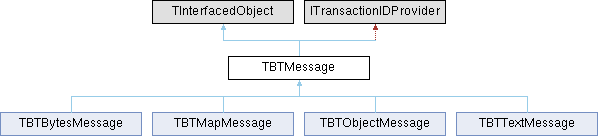
This object represents a message.
| TBTMessage::Acknowledge |
( |
| ) |
|
Acknowledges all consumed messages of the session of this consumed message.
All consumed messages support the acknowledge method for use when a client has specified that its session's consumed messages are to be explicitly acknowledged. By invoking acknowledge on a consumed message, a client acknowledges all messages consumed by the session that the message was delivered to.
Calls to acknowledge are ignored for both transacted sessions and sessions specified to use implicit acknowledgement modes.
A client may individually acknowledge each message as it is consumed, or it may choose to acknowledge messages as an application-defined group (which is done by calling acknowledge on the last received message of the group, thereby acknowledging all messages consumed by the session.)
Messages that have been received but not acknowledged may be redelivered.
- Exceptions
-
| EMQException | if the provider fails to acknowledge the messages due to some internal error. |
| IllegalStateException | if this method is called on a closed session. |
| TDateTime TBTMessage::JMSExpiration |
The message's expiration value.
When a message is sent, the JMSExpiration header field is left unassigned. After completion of the send or publish method, it holds the expiration time of the message. This is the sum of the time-to-live value specified by the client and the GMT at the time of the send or publish.
If the time-to-live is specified as zero, JMSExpiration is set to zero to indicate that the message does not expire.
When a message's expiration time is reached, a provider should discard it. The API does not define any form of notification of message expiration.
Clients should not receive messages that have expired; however, the API does not guarantee that this will not happen.
- See also
- GetExpiration For reading
-
SetExpiration For writing
| string TBTMessage::JMSMessageID |
The message ID which is set by the provider.
The JMSMessageID header field contains a value that uniquely identifies each message sent by a provider.
A JMSMessageID is a String value that should function as a unique key for identifying messages in a historical repository. The exact scope of uniqueness is provider-defined. It should at least cover all messages for a specific installation of a provider, where an installation is some connected set of message routers.
Uniqueness of message ID values across different providers is not required.
- See also
- GetMessageID For reading
-
SetMessageID For writing
| Integer TBTMessage::JMSPriority |
The message priority level.
Providers set this field when a message is sent. To send a message with a priority, use the MessageProducer's Priority property.
The minimum, maximum and default values are broker API dependent:
The API defines ten levels of priority value, with 0 as the lowest priority and 9 as the highest. In addition, clients should consider priorities 0-4 as gradations of normal priority and priorities 5-9 as gradations of expedited priority.
The API does not require that a provider strictly implement priority ordering of messages; however, it should do its best to deliver expedited messages ahead of normal messages.
The possible values depend on broker and protocol version.
- See also
- GetPriority For reading
-
SetPriority For writing
| Boolean TBTMessage::JMSRedelivered |
Redelivered - True if this message has been redelivered to this or another consumer before being acknowledged successfully.
An indication of whether this message is being redelivered.
If a client receives a message with the JMSRedelivered field set, it is likely, but not guaranteed, that this message was delivered earlier but that its receipt was not acknowledged at that time.
- See also
- GetJMSRedelivered For reading
-
SetJMSRedelivered For writing
The Destination object to which a reply to this message should be sent.
The JMSReplyTo header field contains the destination where a reply to the current message should be sent. If it is null, no reply is expected. The destination may be either a IQueue object or a ITopic object.
Messages sent with a null JMSReplyTo value may be a notification of some event, or they may just be some data the sender thinks is of interest.
Messages with a JMSReplyTo value typically expect a response. A response is optional; it is up to the client to decide. These messages are called requests. A message sent in response to a request is called a reply.
In some cases a client may wish to match a request it sent earlier with a reply it has just received. The client can use the JMSCorrelationID header field for this purpose.
- See also
- GetReplyTo For reading
-
SetReplyTo For writing
| TDateTime TBTMessage::JMSTimestamp |
The timestamp the broker added to the message.
The JMSTimestamp header field contains the time a message was handed off to a provider to be sent. It is not the time the message was actually transmitted, because the actual send may occur later due to transactions or other client-side queueing of messages.
When a message is sent, JMSTimestamp is ignored. When the send or publish method returns, it contains a time value somewhere in the interval between the call and the return. The value is in the format of a normal millis time value in the Java programming language.
- See also
- GetTimestamp For reading
-
SetTimestamp For writing

 1.10.0